
Dealing with a landlord dispute or eviction can be stressful — but understanding your rights under Texas law can make all the difference. Before you even think about court, there’s a powerful, cost-effective tool you should use first: a well-written demand letter.
This isn't just another letter. It's a formal, strategic document that lays out your side of the story, explains your rights, and clearly states what it will take to make things right. It's often the first and most important step toward resolving a conflict without the need for a lawsuit.
What is a Demand Letter and Why Is It Your First Step in a Texas Dispute?

Before diving into how to write one, it's helpful to understand what a demand letter is and its role in negotiations. Think of it as a professional, final warning shot. It’s your official, on-the-record attempt to resolve a disagreement before taking legal action. For both tenants and landlords, it is a critical tool for protecting your property rights.
A demand letter is far more than an angry complaint. It’s a calculated move that puts the other party on formal notice. You're showing them you're serious, you know your rights, and you're prepared to escalate the matter if they don't respond. By clearly presenting the facts and giving them a hard deadline, you create a structured opportunity to settle things quickly and efficiently.
Why Is a Demand Letter So Critical in Texas Landlord-Tenant Law?
For many people in Texas, receiving a formal demand letter is the moment a casual disagreement turns into a serious legal issue. It forces them to stop and consider the time, money, and hassle of a potential lawsuit. More often than not, a professionally crafted letter from a tenant or landlord gets results without anyone ever seeing the inside of a courtroom.
Here’s why it works so well:
- It Shows You Mean Business: A formal letter signals that you've documented everything and are weighing your legal options, whether you're a tenant seeking repairs or a landlord demanding unpaid rent.
- It Creates a Paper Trail: If you do end up in court, this letter—and your proof of delivery—becomes Exhibit A. It shows a judge you acted in good faith to solve the problem first.
- It Forces You to Get Organized: Writing a demand letter makes you line up your ducks. You have to gather all the facts, documents, and dates into a clear, compelling story that supports your claim.
- It Gets You Paid Faster: Whether you’re a landlord chasing down unpaid rent or a tenant trying to get a security deposit back, this letter is often the push the other party needs to finally resolve the issue.
In so many cases, a demand letter is the key that unlocks a stalled negotiation. It changes the entire dynamic, moving the issue from a simple dispute to a formal pre-litigation stage. The result? A much faster and cheaper resolution for everyone involved.
To be effective, your demand letter needs to include specific information presented clearly and professionally. Here’s a checklist of the essential components.
Key Components for Your Texas Demand Letter
This checklist breaks down the essential elements your demand letter must include to be clear, professional, and effective in a legal context.
| Component | What It Accomplishes |
|---|---|
| Your Information | Clearly identifies who you are and where you can be contacted. |
| Recipient’s Information | Formally names the person or business you have a dispute with. |
| Date | Establishes a timeline for the dispute and your communication. |
| Clear Subject Line | Immediately tells the recipient what the letter is about (e.g., "Demand for Return of Security Deposit," "Final Notice of Unpaid Rent"). |
| Factual Background | Briefly and factually explains the history of the dispute. No emotion, just the facts. |
| The Specific Demand | States exactly what you want—a specific dollar amount, a repair, the return of property. |
| Deadline for Action | Gives the recipient a reasonable but firm deadline to respond (e.g., 14 or 30 days). |
| Consequences of Inaction | Clearly states what you will do if they fail to meet your demand (e.g., "pursue all available legal remedies"). |
| Supporting Documents | Mentions any enclosed or attached evidence like invoices, contracts, or photos. |
| Your Signature | Makes the document official and personally validates your claim. |
Including each of these elements ensures your letter is taken seriously and serves as a solid foundation if legal action becomes necessary.
What the Texas Property Code Says
It’s important to know that Texas law doesn’t require a specific, rigid template for a demand letter. There's no magic formula you have to follow.
However, certain elements—like the ones listed above—make a letter far more powerful, especially if it ends up as evidence in a lawsuit. A letter’s success really boils down to how clearly it’s written, how strong your facts are, and whether the other person is willing to find a reasonable solution. This is why professionalism and clarity are non-negotiable, and referencing specific sections of the Texas Property Code can significantly strengthen your position.
How to Draft a Demand Letter That Gets Results

A powerful demand letter Texas residents can count on is much more than a simple list of complaints. Think of it as a professional, structured document that lays out a clear story and gives the other person a final, formal chance to make things right.
Getting the structure and tone right from the very beginning is critical if you want to be taken seriously.
Your letter needs to start with the basics: identify everyone involved. Put your full name and contact information, along with the recipient's full name and address. Then, use a clear, direct subject line like "Demand for Payment of Overdue Rent" or "Final Demand for Return of Security Deposit for 123 Main St." This sets a no-nonsense tone and gets straight to the point.
Lay Out the Facts—Just the Facts
After the introductions, you need to tell the story of what happened. This isn't the time for emotion or accusations. Stick to a concise, chronological summary of the dispute. Your goal is to create a clear timeline that a judge—or anyone else—can follow without getting confused.
Example Scenario: A tenant is demanding their security deposit back. The narrative should include objective facts like:
- The date the lease was signed and the security deposit amount paid ($1,500).
- The lease end date and the exact date the tenant moved out.
- The date the tenant provided their forwarding address in writing.
- The number of days that have passed since the landlord's 30-day deadline under Texas Property Code § 92.103.
This factual, organized approach builds a credible foundation for your demand. It shows you're serious and well-prepared.
Connect the Facts to the Law
This is where you show you've done your homework. You need to connect the story you just told to the specific law or contract clause that supports your claim. You don't have to write a legal brief, but referencing a specific rule gives your letter real teeth.
A landlord dealing with a tenant who broke the lease would point to the exact clause in the rental agreement that was violated. A tenant whose landlord won't make critical repairs would cite the landlord's duty under the Texas Property Code. Mentioning the legal basis shows the other side that your demand isn't just a personal grievance; it's grounded in a legal obligation they’ve failed to meet.
For more on what counts as a serious landlord violation, see our guide on what happens when a landlord breaches a lease agreement.
The key here is being direct and specific. Citing a section of the Texas Property Code or a specific article in a signed contract transforms your letter from a complaint into a formal legal notice. It sends a powerful message that you are prepared to enforce your rights.
Make a Clear Demand and Set a Deadline
Now for the heart of the letter: the demand itself. Be specific and unambiguous.
Don't just ask for "compensation for damages." State that you demand "$750 to cover the cost of repairing the broken window and damaged drywall." Clarity leaves zero room for misinterpretation.
Just as important is setting a firm—but reasonable—deadline. Giving 14 to 30 days is standard. It shows you're not trying to corner them, but you also expect action. Phrasing it like, "Please remit payment in full by 5:00 PM on October 31, 2024," adds a necessary sense of professional urgency.
End with a Professional Warning
Finally, you must state what happens if they ignore you. This isn't a threat; it's a calm, professional statement of your next steps. This reinforces that you're serious about resolving the issue but are fully prepared to escalate if you have to.
A strong, effective closing statement is simple:
"If I do not receive a satisfactory response by the deadline specified above, I will have no alternative but to pursue all available legal remedies to resolve this matter."
That one sentence does three things perfectly: it restates the deadline, shows you’d prefer to settle out of court, and makes it crystal clear that you're ready to file a lawsuit if your demand is ignored. This balance of professionalism and firmness is what makes a demand letter work.
Real-World Scenarios: How a Demand Letter Can Help

A demand letter Texas residents can use isn't just a one-trick pony for a single type of problem. It's an incredibly versatile tool. Its real power is how it can be adapted to all sorts of disputes, from landlord-tenant disagreements to freelance contracts gone wrong.
Let's walk through a few practical, real-world examples that help you understand your legal options. Seeing how this document works in action can help you frame your own dispute, turning a frustrating mess into a clear, professional, and actionable request.
For Tenants: How to Get Your Security Deposit Back
This is one of the most common disputes between tenants and landlords. You moved out, you left the place spotless, and you provided your landlord with your forwarding address in writing. But now, it's been over a month, and your $2,000 security deposit is nowhere to be found.
Under Texas Property Code § 92.103, your landlord has exactly 30 days after you move out to either refund your deposit or give you an itemized list of deductions. If they fail to do so, a demand letter is your next move.
Here’s a step-by-step approach for your letter:
"As you know, my tenancy at 123 Oak Lane ended on September 30, 2024. I provided my forwarding address to you in writing on that date. It has now been over 30 days, and I have not received my $2,000 security deposit or an itemized list of deductions as required by Texas Property Code § 92.103. This letter serves as a formal demand for the immediate return of my full security deposit. Failure to refund the deposit within 14 days will compel me to pursue legal action, where I may be entitled to three times the amount wrongfully withheld, plus attorney's fees."
See how that works? It's firm, it cites the specific law, and it clearly lays out the consequences of ignoring the request. For a much deeper dive on this, check out our guide on how to get your security deposit back from a landlord.
For Landlords: How to Address Unpaid Rent or Damages
Now, let's flip the script. Imagine you’re the landlord. Your tenant is behind on rent, or they just moved out and left behind more than just memories—like a huge hole in the drywall and deep gouges in the hardwood floors.
This isn't "normal wear and tear." This is damage. Your demand letter would be your tool to seek payment for the repairs that the security deposit didn't cover or to demand overdue rent.
You’d want to structure it something like this:
- State the Facts Clearly: "Your lease for 456 Pine Avenue ended on October 15, 2024. During the move-out inspection, we documented a large hole in the living room wall and extensive scratching on the wood flooring, which are not considered normal wear and tear."
- Show Your Work: "We have attached photos of the damage and a repair estimate from a licensed contractor totaling $950. Your $750 security deposit has been applied to this cost, leaving a balance of $200."
- Make the Demand: "We demand payment for the remaining $200 balance within 15 days of the date of this letter to resolve this matter."
For Freelancers & Small Businesses: Breach of Contract
Demand letters are incredibly useful outside of real estate, too. Say you’re a freelance graphic designer. You finished a logo project for a client, the agreed-upon price was $1,200, and you delivered the final files. But now, 60 days have passed, and your invoice is just sitting there, unpaid.
Your demand letter is the perfect way to escalate things professionally. You'd reference your written agreement or email chain, state the facts, attach another copy of the overdue invoice, and demand full payment by a specific date. This one formal step is often all it takes to get an invoice paid when polite emails and phone calls have failed.
These examples show that whether you're a tenant, a landlord, or a business owner, a demand letter gives you a structured way to assert your rights and get what you're owed. This is more important than ever. Civil case filings in Texas have climbed by a staggering 22 percent since 2019—the largest jump of any case type. With the courts that busy, resolving disputes before they turn into full-blown lawsuits is a smarter strategy for everyone.
How to Send Your Demand Letter and Prove It Was Delivered
Even the best-written demand letter is worthless if you can’t prove the other person actually got it.
Dropping it in a regular mailbox or firing off a quick email just won’t cut it. All that does is give the other side an easy out: "Sorry, I never saw it."
This isn't just about making sure the letter arrives. It's about creating an undeniable paper trail that will hold up in court if things escalate. How you send the letter is a strategic move that can make or break your case later on.
The Gold Standard: Certified Mail with Return Receipt
For almost every situation in Texas, your best bet is Certified Mail with Return Receipt Requested from the post office. There’s a reason this is the go-to method for any serious legal notice.
When you send a letter this way, you get a tracking number and, more importantly, that little green card—the return receipt—signed by the person who received it. That signature is your ironclad proof.
Here’s why it’s so effective:
- It creates undeniable proof of delivery. That signed receipt makes it almost impossible for someone to claim they never got your letter.
- It sets a clear timeline. The date on that green card officially starts the clock on the deadline you gave them in your letter.
- It shows you mean business. Using Certified Mail sends a clear signal that this isn't some casual note—it's a formal, legal demand.
This method is affordable, reliable, and recognized by every court in Texas as a valid way to serve these kinds of notices.
Think of that signed return receipt as your insurance policy. If you end up in court and the other party claims they were never warned, that little green card becomes your most powerful piece of evidence. It proves you acted in good faith to resolve the issue before taking further action.
When Other Delivery Methods Make Sense
While Certified Mail is usually the right call, some situations demand a different approach. The goal is always the same: get solid proof of delivery.
Hiring a Professional Process Server
If things are already heated or you suspect the person will actively dodge your letter, hiring a professional process server is a smart move. They will personally hand-deliver the letter and provide you with a sworn affidavit of service. This is the strongest proof you can get and is often used when you know a lawsuit is right around the corner.
Using Courier Services
Services like FedEx or UPS that require a signature are also a solid option. They provide detailed tracking and a digital copy of the signature, which creates a strong record. This can be a great choice if you need the letter delivered faster than standard mail.
A Word of Caution on Email and Fax
Relying on email alone is risky. It’s too easy for someone to claim it went to spam or that they simply never opened it. If you want to use email, send it after you’ve already sent a physical copy via Certified Mail.
If you absolutely must send it by fax, look into modern options for sending a fax that give you a detailed delivery confirmation report. But no matter what, nothing beats having that physical letter with a real signature on file. It’s always your safest bet.
What Happens After You Send the Letter? Step-by-Step Responses
You've sent the demand letter. Now comes the hard part: waiting.
This is where the real strategy begins. The ball is in their court, and how they respond—or if they respond at all—dictates your next move. Don't mistake this quiet period for inaction. It's time to prepare for every possible outcome so you can stay in control of the situation.
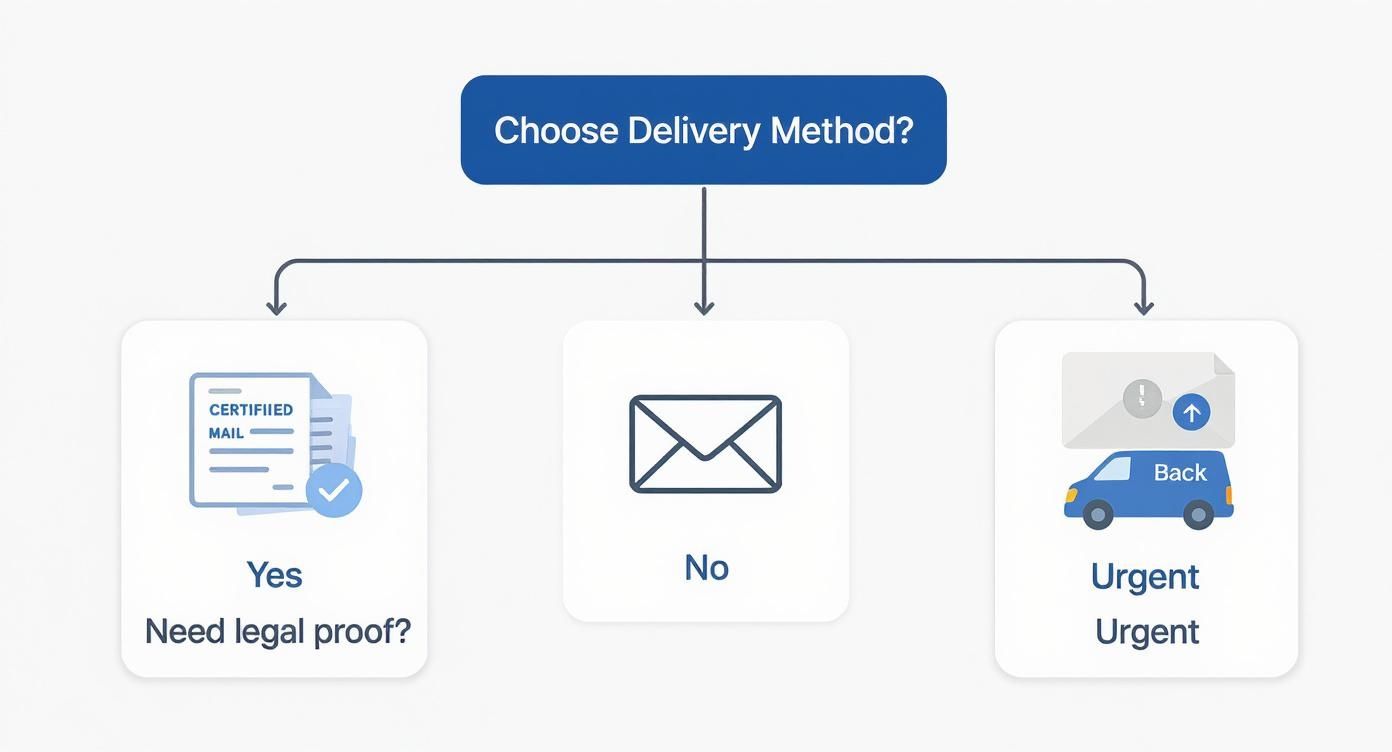
As you can see, choosing a delivery method with proof, like Certified Mail, is more than just a formality. It’s a foundational step that gives you leverage when you get to this post-delivery phase.
Let's walk through the three most common ways this can play out.
Outcome #1: They Agree to Your Terms (The Best Case)
This is the home run. The other party gets in touch and agrees to what you've demanded. They might call you, or you might get a formal letter accepting responsibility and making arrangements to pay or act.
If this happens, your first and most important job is to get it in writing. Do not rely on a handshake or a verbal promise.
You need to draft a formal release agreement or a settlement agreement. This document is a simple contract that makes it official: in exchange for their payment or action, you agree to drop the issue and release them from any further claims. Once both sides sign it, the dispute is legally over.
Outcome #2: They Come Back with a Counteroffer
Far more common than a simple "yes" is a counteroffer. They might dispute the amount you’re asking for, question some of your claims, or offer a different type of solution altogether.
Don't see this as a rejection. It's an invitation to the negotiating table.
Take a step back and look at their offer objectively. Is it a reasonable starting point? Does it get you close to what you need? The key here is to keep the conversation professional and calm. Negotiation is how most of these disputes get resolved without ever seeing a courtroom.
If you’re stuck, this is a great time to explore options like real estate mediation can also be a valuable step to bring in a neutral third party. And remember, once you find that middle ground, get it finalized in a signed settlement agreement.
Expert Insight: A fair settlement you get your hands on today is almost always better than a perfect judgment you might win in court a year from now. The goal is resolution, not a drawn-out battle.
Outcome #3: They Dispute Everything or Just Go Silent
This is the most frustrating outcome. Your deadline comes and goes, and you're met with complete silence. Or, you get a letter back that dismisses your claims and refuses to do anything.
If they're just ignoring you, you have a decision to make. You could send one final, brief follow-up. A simple email or letter stating that your deadline has passed and you are now preparing to take legal action can sometimes be enough to jolt them into responding.
But if they’ve outright denied everything or continue to ghost you, the time for talking is over. It's a clear signal that you need to escalate. Your next step is likely filing a claim in a Texas Justice Court (the small claims court) or contacting a Texas landlord-tenant lawyer to discuss litigation.
This table breaks down common responses to a demand letter and gives you a clear, strategic next step for each scenario.
Responding to Different Outcomes
| If They Respond By… | Your Strategic Next Step |
|---|---|
| Agreeing to Your Terms | Immediately draft a written settlement and release agreement. Do not accept payment or action until it's signed by both parties. |
| Making a Counteroffer | Evaluate their offer objectively. Respond professionally to keep negotiations open. If talks stall, consider mediation. |
| Ignoring Your Letter | Send one final, firm follow-up message after the deadline. State your intent to pursue legal action if you don't hear back immediately. |
| Denying Your Claim | Stop direct communication. It's time to file a lawsuit or consult with an attorney to assess the strength of your case for court. |
No matter how they respond, having a plan keeps you from reacting emotionally and helps you make a smart, calculated decision to protect your interests.
When It’s Time to Hire a Texas Landlord-Tenant Attorney
While a solid demand letter Texas law supports can be a powerful first step, it’s not a magic bullet. Sometimes, you need more than a strongly worded letter to get results.
Knowing when to stop handling a dispute yourself and call in professional legal help is one of the most critical decisions you can make. It can save you from costly missteps and put you in the strongest possible position to protect your rights.
High Stakes and Complex Issues
Some situations are just too risky to DIY. If your case involves a large sum of money, a serious eviction proceeding, or a convoluted lease full of legalese, you need an expert in your corner. This isn't the time for on-the-job training.
An experienced Texas landlord tenant lawyer knows what to look for. They can spot legal arguments you’d miss and make sure every detail is handled perfectly from day one. Plus, a demand letter coming from a law firm on official letterhead often gets a much faster—and more serious—response.
The Other Side Gets a Lawyer
This is the biggest red flag of all. The second the other party hires an attorney, the game has changed. Their lawyer’s only job is to protect their client's interests, not to play fair with you.
Going up against a trained legal professional without one of your own is like showing up to a gunfight with a water pistol. They know the rules, the tactics, and the legal precedents you don't. Hiring an eviction attorney or civil litigator levels the playing field and ensures your rights are defended with equal force.
Hostile Responses or Tight Deadlines
You should also get legal help if the response you receive is dismissive, threatening, or just plain unreasonable. A hostile reply is a clear signal that the other party isn’t interested in negotiating in good faith. They’re daring you to take the next step. An attorney can step in to de-escalate the situation or, if necessary, prepare for a fight.
Finally, keep a close eye on the calendar. In Texas, you only have a certain amount of time to file a lawsuit—this is called the statute of limitations. If that deadline is getting close, you need to move fast. An attorney can quickly assess your case and file the right paperwork to preserve your claim before it’s too late. Don't let your right to justice expire because you waited too long.
If you need help with an eviction, lease issue, or rental dispute, contact The Law Office of Bryan Fagan, PLLC for a free consultation today. Our experienced team is ready to protect your rights. Contact us today for a free consultation to discuss your case.

![Graphic design featuring the title "8 Valid Reasons to Break a Lease in Texas [2025 Guide]" with decorative elements like a pen and paper, emphasizing tenant rights and legal guidance in Texas.](https://texastenantlawyers.com/wp-content/uploads/2025/11/featured-image-7ebe2aec-eacb-4e61-8e85-9c298b07ad11.jpg)