
Dealing with a landlord dispute or a broken promise can be stressful—but understanding your rights under Texas law can make all the difference. Many people believe that if an agreement isn't in writing, it's not a real contract. In Texas, that’s simply not true.
The simple fact is, verbal contracts in Texas can be legally binding and fully enforceable in court, as long as they meet specific legal requirements. Whether you're a tenant promised a repair or a landlord who made a handshake deal, knowing your rights is the first step toward a fair resolution.
The Truth About Verbal Contracts in Texas

When someone backs out of a spoken promise, it’s natural to feel frustrated and helpless. Without a signed document, you might think you have no legal leg to stand on.
But Texas law understands that not every agreement comes with a formal, signed document. A handshake deal, a spoken promise, or a simple oral agreement can absolutely create a valid contract. For that verbal agreement to hold up in court, however, it has to contain the same core elements as any written contract. If even one is missing, a judge will likely rule that your "contract" isn't enforceable.
What the Texas Property Code Says About Contracts
For a verbal agreement to be legally binding, a court will look for three key components that prove both sides intended to create a binding deal.
These are the non-negotiables:
- A Clear Offer: One person had to clearly propose the terms of the deal. For example: "I will reduce your rent by $100 this month if you paint the living room by Friday."
- An Unambiguous Acceptance: The other person had to clearly agree to those exact terms. A simple, "Yes, I agree to that," is usually enough.
- Mutual Consideration: This is the legal way of saying each person has to give and receive something of value—the "this for that." In our painting example, the landlord gives up $100 in rent, and the tenant gives up their time and labor.
If your verbal agreement has these three elements, you're on solid ground. This foundation is critical for protecting your rights when a spoken promise is broken, especially in disputes handled by a Texas landlord tenant lawyer.
When is a Verbal Contract Enforceable in Texas?
To make it even clearer, here’s a quick breakdown of common scenarios where a verbal agreement might—or might not—be valid in Texas.
| Scenario | Likely Enforceable? | Key Reason |
|---|---|---|
| A one-time repair job for $500 | Yes | The agreement can be completed in under one year. |
| A 6-month apartment lease | Yes | Leases for one year or less do not have to be in writing under the Texas Property Code. |
| An agreement to buy a used appliance for $450 | Yes | Sales of goods under $500 don't require a written contract. |
| An 18-month employment contract | No | The contract cannot be performed within one year (Statute of Frauds). |
| An agreement to buy a house | No | Real estate transactions must be in writing (Statute of Frauds). |
| A promise to pay someone else's rent debt | No | Suretyship agreements must be in writing (Statute of Frauds). |
While this table offers a general guide, every situation is unique. An experienced Texas contract lawyer can help you figure out if your specific verbal agreement meets these crucial standards and can be upheld in court.
What Makes a Handshake Deal Legally Binding?
For a verbal agreement to be more than just a casual chat, it needs to stand on a solid legal foundation. A Texas court won't enforce a vague promise. Instead, it looks for specific, core components that prove a real contract was actually formed.
In Texas, a verbal contract is only as good as these four elements.
The Four Pillars of a Valid Contract
To prove your spoken agreement is a real, enforceable contract, you have to show that all four of these conditions were met:
A Clear Offer: Someone has to make a specific, definite proposal. It can't be vague. For example, a landlord might say, "I'll knock $100 off next month's rent if you paint the living room before the 15th." That’s a clear offer with no room for confusion.
Unambiguous Acceptance: The other person has to clearly and unequivocally agree to the exact terms offered. A simple, "You've got a deal," works. But if the tenant replies with, "I'll do it, but for a $150 discount," that isn't acceptance. It's a counteroffer, which ends the original offer.
Mutual Consideration: This is the legal term for what each person gives up—the "this for that" of the agreement. In our painting scenario, the landlord's consideration is the $100 rent credit. The tenant's consideration is their labor and time. Both sides have to bring something of value to the table.
A "Meeting of the Minds": This is often the trickiest part to prove. It means both of you genuinely understood and agreed to the essential terms of the deal. If there was a major misunderstanding about what was being promised, you never truly had an agreement.
Key Takeaway: A "meeting of the minds" is just a formal way of saying everyone was on the same page. If one person thought the deal was for painting the bedroom and the other meant the living room, a valid contract probably never existed.
A Real-World Tenant-Landlord Scenario
Let's say your dishwasher suddenly breaks. You call your landlord, who tells you, "Look, if you handle getting it repaired yourself, I'll waive your pet fee for the rest of the lease." You agree on the spot and book a repair technician.
Here's how that breaks down:
- The Offer was the landlord’s promise to drop the pet fee.
- The Acceptance was your verbal "yes" to the deal.
- The Consideration was the landlord giving up fee income in exchange for you giving your time and money to fix the appliance.
- A Meeting of the Minds happened because you both knew exactly what was being exchanged.
This verbal agreement has all the right ingredients to be legally binding. Still, it’s always a good idea to know what a formal, written lease requires. You can learn more about Texas lease agreement laws in our comprehensive guide.
When a Handshake Is Not Enough: The Statute of Frauds
While many verbal agreements are valid in Texas, the law draws a hard line for certain types of deals. This legal rule is called the Statute of Frauds, and it requires certain high-stakes agreements to be in writing to be enforceable. It’s designed to prevent fraud and misunderstandings in major transactions.
If your spoken agreement falls into one of these categories, a court simply won't enforce it.
Agreements That Absolutely Must Be in Writing
It’s critical to know where the law draws this line. A verbal promise might feel binding in the moment, but if it touches on any of the following, it’s not legally valid without a written document.
- Real Estate Transactions: This is a big one. Any contract for the sale or purchase of property, from a house to a plot of land, is completely unenforceable if it's just verbal.
- Leases Longer Than One Year: Under the Texas Property Code, if you’re renting a property for more than 12 months, the lease must be in writing. A spoken agreement for an 18-month lease won’t hold up.
- Agreements That Can’t Be Finished Within a Year: This is a catch-all category. If the terms of the deal make it impossible to complete within one year from the day you make the agreement, it needs to be written down.
- Promises to Pay Someone Else’s Debt: Legally called a "suretyship agreement," if you promise to cover the debt or obligation of another person, that promise has to be in writing.
When it comes to real estate, a verbal promise is never enough. The Statute of Frauds is strict, as detailed by the specific requirements for real estate contracts.
Why the Law Demands a Paper Trail
The logic here is simple: for major commitments, memories fade and people’s stories change. A written record prevents disputes. Imagine trying to argue about rent amounts or repair duties a year into a two-year verbal lease—it would be a mess of "he said, she said."
The Texas Statute of Frauds limits the enforceability of these oral agreements to prevent exactly this kind of misunderstanding. Specifically, verbal contracts involving real estate, deals that can’t be performed within a year, and sales of goods over $500 must be in writing. You can find more details about these legal requirements on upcounsel.com.
A Practical Example: Let's say you verbally agree with a property owner to lease a retail space for three years. You shake on it and start making business plans. A month later, the owner gets a better offer and tells you the deal is off. Because your lease was for more than one year, your verbal agreement is not enforceable. Without a signed contract, you have no legal power to protect your new business. This is a situation where an eviction attorney could provide critical guidance.
How to Prove a Verbal Contract in Court
When a handshake deal goes south, the real fight isn't just proving a contract existed—it's proving what you both actually agreed to.
In a Texas courtroom, the burden of proof falls on you if you are the person trying to enforce the agreement. That means it’s your job to convince the judge that your side of the story is the right one. Without a signed piece of paper, that can feel like a steep climb, but it is possible with the right evidence.
This infographic lays out a few key reasons why some verbal contracts, especially those involving big-ticket items like real estate, just won't hold up without a written agreement under the Statute of Frauds.
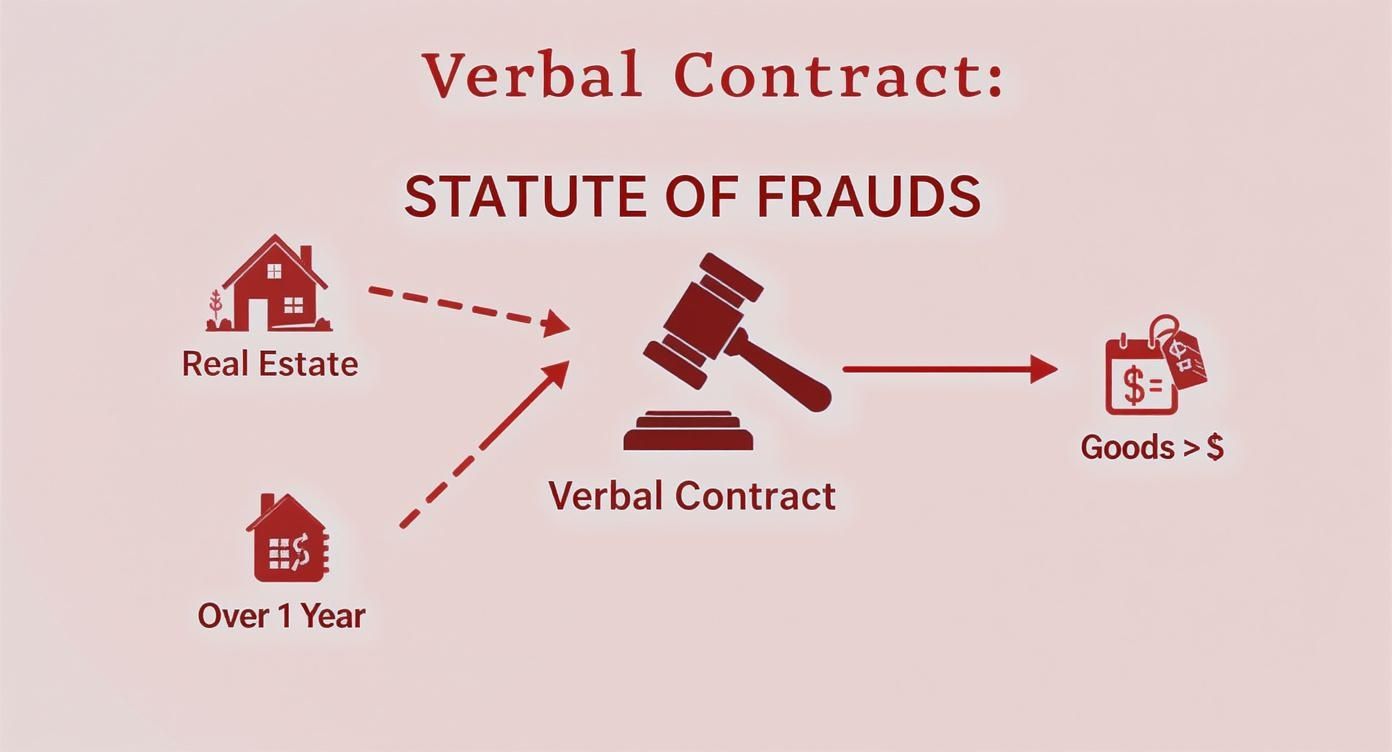
As you can see, high-stakes agreements that involve property or long-term promises legally demand a paper trail. It's the law's way of preventing "he said, she said" battles over things that are too important to leave to memory.
Step-by-Step: Gathering Your Evidence
Since there’s no signed document, Texas courts rely on secondary evidence to uncover the truth. To meet your burden of proof, your goal is to collect concrete proof that backs up your claim. You can find more practical advice on enforcing verbal contracts at diversityinbrewing.com.
Here are the most convincing types of evidence you can use:
- Witness Testimony: Was anyone else there when the deal was struck? A neutral third party who overheard the conversation and can confirm the terms is an incredibly powerful asset in court.
- Written Correspondence: Dig through everything. Your text messages, emails, and even letters can be gold. A quick text saying, "Just confirming I'll pay you $500 for the fence repair on Friday," can become undeniable proof of your agreement.
- Proof of Payment: Money talks. Financial records like canceled checks, bank statements, and Zelle or Venmo histories show that money changed hands for a reason—the reason being your agreement.
- Partial Performance: This is all about actions speaking louder than words. If you verbally agreed to paint your landlord’s apartment for a rent discount, proof that you bought paint and started the work demonstrates you were holding up your end of the bargain.
A Real-World Scenario: Imagine a tenant agrees to a six-month lease over the phone. Two months in, the landlord tries to evict them, claiming no such deal existed. The tenant can fight back by presenting bank statements showing two rent payments, texts confirming the move-in date, and testimony from a friend who helped them move in. Suddenly, the landlord's claim that "there was no contract" starts to fall apart, strengthening the tenant's rights.
By pulling together these different threads of proof, you can weave a compelling story for the court and dramatically boost your odds of enforcing your verbal contract in Texas.
Taking Legal Action for a Broken Promise
When someone goes back on their word, knowing what to do next is everything. You have to be ready to enforce your rights. The first step is to create an official record of the problem.
This usually begins with a demand letter. A strong demand letter, especially one drafted by a Texas landlord-tenant lawyer, will clearly lay out the terms of your spoken agreement, explain how it was broken, and state what you need to make things right. It signals you're serious and creates a paper trail that can become crucial evidence.
Don't Miss the Legal Deadline
If a letter doesn't work, your next option may be a lawsuit. But you can't wait forever. Texas has a strict deadline for filing a breach of contract lawsuit, known as the statute of limitations.
Under Texas law, you generally have four years from the date the promise was broken to file a lawsuit for most verbal contracts in Texas. This time limit pushes people to resolve disputes while evidence is still fresh and memories are clear.
Crucial Takeaway: If you miss that four-year deadline, you lose your right to sue, no matter how solid your case is. Acting quickly is essential.
Filing a Lawsuit for Breach of a Verbal Contract
Deciding to sue starts with filing a "petition" in the right Texas court. This document officially kicks off the legal process.
Your petition needs to clearly detail three things:
- That a verbal agreement existed and what its terms were.
- How the other person failed to do what they promised.
- The financial damages or other losses you suffered as a result.
These handshake-deal disputes are common between landlords and tenants. Maybe a landlord verbally promised to fix a leaky roof but never did, causing water damage. Or perhaps a tenant agreed to certain upkeep duties and then ignored them. When you're dealing with a landlord's breach of a lease agreement, understanding these legal steps is critical. Working with an attorney from the start helps ensure your rights are protected.
Best Practices to Protect Yourself
While it’s good to know you can enforce verbal contracts in Texas, the smartest move is to prevent a dispute before it ever starts. A few simple, proactive steps can save you from stress and the high cost of a courtroom battle.
The golden rule is also the simplest one: get it in writing whenever possible.
Even a basic document is infinitely stronger than a spoken promise. A straightforward, clear agreement protects everyone involved and leaves no room for "he said, she said" arguments.
Creating a Simple Written Record
At a minimum, any written agreement needs to spell out the core terms of the deal. A solid contract should always cover the basics:
- Who is involved: The full legal names of every person or company.
- What is being exchanged: A specific description of the goods or services. Be clear!
- How much it costs: The exact price, when payments are due, and any other financial details.
- When it happens: Key dates and deadlines, like when work starts, when it ends, or the term of a lease.
When a Formal Contract Isn't Practical
Sometimes, a handshake deal is just how things get done. In those moments, you can still create a paper trail to protect yourself.
Right after your conversation, send a quick follow-up email or text message.
Pro Tip: Your message should politely recap what you just agreed to. Something like, "Great talking! Just confirming we're set for me to paint the living room for a $150 rent credit, with the work done by the 30th." This creates a timestamped record that the other person can easily confirm.
That simple text could become your most powerful piece of evidence if things go south.
If you’re a tenant dealing with recurring verbal promises from a difficult landlord, it helps to know your next steps. You can learn more about how to file a complaint against a landlord if the problems persist. And for anyone looking to build stronger agreements from the start, check out these best practices for contract management.
A Few Common Questions About Oral Agreements
Navigating a dispute over a spoken promise can feel overwhelming. Here are clear, direct answers to some of the most common questions we hear about verbal contracts in Texas.
Are Text Messages a Written Contract?
Sometimes, yes. A text message chain can serve as proof of a deal and, in certain situations, might even satisfy the “in writing” requirement under the Statute of Frauds.
For a text exchange to hold up in court, it has to clearly show an offer, an acceptance, and a “meeting of the minds” on the key terms. The risk is that text conversations can be ambiguous. A judge will have to piece together the entire exchange to decide if it truly forms a complete, undeniable contract.
What Happens If I Can't Prove the Terms of Our Deal?
This is the single biggest hurdle with verbal agreements. If you can’t back up your claim with solid evidence—like witnesses, emails, texts, or proof of performance—it boils down to a messy "he said, she said" situation.
In court, you have the burden of proof. If you can't meet it, a judge will likely find that you haven't proven your case, and it could be dismissed. Without clear evidence, enforcing a spoken promise is nearly impossible.
Can I Sue Over a Broken Verbal Agreement for More Than $500?
It depends on what the agreement was for.
Under the Texas Uniform Commercial Code, any contract for the sale of goods priced at $500 or more must be in writing. So, if you verbally agreed to buy a used refrigerator for $600 and the seller backs out, that oral contract is likely unenforceable.
However, if the agreement was for a service—say, a one-time landscaping job for $600—the verbal contract could still be perfectly valid. That $500 rule is specific to the sale of physical goods, not services.
If you need help with an eviction, lease issue, or rental dispute, contact The Law Office of Bryan Fagan, PLLC for a free consultation today. Let’s get you the clear, practical guidance you deserve. https://texastenantlawyers.com

![Graphic design featuring the title "8 Valid Reasons to Break a Lease in Texas [2025 Guide]" with decorative elements like a pen and paper, emphasizing tenant rights and legal guidance in Texas.](https://texastenantlawyers.com/wp-content/uploads/2025/11/featured-image-7ebe2aec-eacb-4e61-8e85-9c298b07ad11.jpg)