
Dealing with a landlord dispute can be stressful — but understanding your rights under Texas law can make all the difference. When a landlord uses threats, illegal lockouts, or cuts your utilities just to pressure you, that's not just bad behavior—it's harassment. And under Texas law, those actions are unlawful. You have clear rights to protect your home and your peace of mind.
How Texas Landlord Harassment Laws Protect You
The Texas Property Code isn't just a dense legal document; it's your shield. It draws a clear line, defining what a landlord can and cannot do. It’s designed to protect you from common intimidation tactics, like a landlord showing up unannounced or threatening you for asking for necessary repairs.
Think of these laws as your first line of defense. Key protections from a Texas landlord tenant lawyer perspective include:
- Illegal Entry Limits: Under Texas Property Code § 92.0081, landlords can't just barge in whenever they feel like it. They must follow the entry terms of your lease.
- Anti-Retaliation Rules:Texas Property Code § 92.331 protects you when you stand up for your rights. A landlord can't legally evict you just because you requested a repair or reported a code violation.
- Utility Shut-offs: Your landlord can't turn off your water or electricity to force you out. Doing so is an illegal tactic.
- Right to Quiet Enjoyment: This is a fundamental tenant right. It means you are entitled to live in your home without constant intimidation, disruption, or abuse.
Getting familiar with these specific codes empowers you to act with confidence.
Key Tenant Protections Under the Property Code
Let’s break it down in simple terms. Section 92.0081 is about your privacy. It ensures your landlord gives you proper notice as required by your lease before entering your home. It’s the difference between a scheduled maintenance visit and a sudden, unnerving knock on the door.
You deserve a home free from intimidation and intrusion.
Then there’s Section 92.331, which is your protection against retaliation. For example, if you report a broken heater, your landlord can't legally respond by jacking up your rent or starting the eviction process. This law ensures you can demand a safe home without fear of punishment.
Building Your Record of Abuse
When harassment starts, you need to think like a detective gathering clues. Your best weapon is a solid record of every incident. Vague complaints are easy to dismiss, but a detailed log is hard to ignore.
Take photos of anything that’s broken or any signs of illegal entry. Save every harassing text message and email. And most importantly, write everything down with precise times and dates.
Here are some essential documentation tips:
- Keep a dated log with clear, unemotional descriptions of each event.
- Screenshot any harassing messages, emails, or even call logs. This is your hard proof.
- If anyone else saw or heard the incident, write down their name and what they witnessed.
These records transform your situation from a "he said, she said" dispute into a powerful case backed by evidence. With these facts in hand, you're ready to send a formal notice or consult with an eviction attorney.
Next Steps When Harassment Happens
Living with landlord harassment can feel incredibly disruptive. It’s time to find solid ground by taking clear, decisive action.
First, start that abuse log immediately. Second, send a formal written demand to your landlord citing the Texas Property Code. Here’s a simple step-by-step plan:
- Draft and send a formal notice detailing the harassment via certified mail or email.
- If it continues, file a complaint with your local housing authority or the appropriate court.
- Before things escalate, seek help from a Texas landlord-tenant lawyer.
Why does acting early matter so much?
- It can stop bad behavior before it snowballs into an illegal eviction.
- It creates a clear paper trail showing you tried to resolve the issue calmly.
- It puts your landlord on official notice that you know your rights and won't be pushed around.
If your landlord ignores your formal demands, you have the right to sue for damages and an injunction to stop the behavior. Knowing the law is your best shield. Stay proactive, and you can bring peace back to your home.
Finding Legal Guidance
You don’t have to face this alone. An experienced attorney can review your situation and advise you on the best path forward.
What Counts as Landlord Harassment

It’s one of the toughest things for a tenant to figure out: Is my landlord just being a nuisance, or have they crossed the line into illegal harassment? A single annoying text probably isn't enough to take to court. But a persistent pattern of behavior meant to scare you, disrupt your life, or force you out? That's a different story.
Knowing what counts as landlord harassment Texas law actually recognizes is the first step in standing up for yourself.
In Texas, landlords are forbidden from harassing or intimidating you. This isn't just a suggestion—it's backed by the Texas Property Code and the federal Fair Housing Act. While the code doesn't give a single, neat definition of "harassment," the courts have made it clear through years of cases. Actions like threatening to evict you for no reason, illegally changing your locks, or showing up constantly just to pressure you are all on that list. For a deeper look at what landlords are barred from doing, check out this guide on what landlords cannot do in Texas.
Common Forms of Landlord Harassment
The key to identifying harassment is often spotting a pattern of abuse. When a landlord consistently gets in the way of your ability to live peacefully in your own home, they’re almost certainly breaking the law.
Here are a few real-world scenarios that usually qualify as harassment:
- Illegal Entry: Your landlord shows up and lets themselves in whenever they feel like it, ignoring the notice requirements in your lease. This is a violation of your privacy that can make you feel unsafe in your own home.
- Utility Shut-offs: It's the middle of August in Texas, and your landlord suddenly cuts off your A/C to "encourage" you to move. This is a classic illegal tactic designed to make your home uninhabitable.
- Threats and Intimidation: The landlord won't stop calling or texting, threatening eviction, making things up about you, or using aggressive language. This kind of constant pressure is a clear form of harassment.
- Refusing to Make Repairs: You’ve sent written notice about a major plumbing leak, but they ignore you. Letting the problem get worse not only creates an unsafe home but can also be a deliberate strategy to make you give up and leave.
- Changing the Locks: You get home from work and your key doesn't work. You’ve been locked out of your apartment without any warning or court order. This is an illegal lockout, plain and simple.
Your Right to Quiet Enjoyment
This brings us to a core concept in Texas tenant law: the covenant of quiet enjoyment. This is a fundamental promise built into every single lease, whether it's written down or not. It’s your basic right to live in your home without constant, unreasonable disruptions from your landlord.
Think of it like a protective bubble around your home. Your landlord can’t just pop that bubble with endless unannounced visits, loud construction at all hours, or any other action that destroys your peace and quiet.
When a landlord's actions make it impossible for you to peacefully live in your home, they are very likely breaking this promise. This is why documenting every single incident is so important—it’s the evidence you need to prove they’ve violated your tenant rights.
Distinguishing Harassment from Legal Actions
Now, not every annoying thing a landlord does is illegal. They have rights, too. They can enter your apartment to fix a burst pipe (with proper notice, if possible) or start the formal, legal eviction process if you haven’t paid rent.
The difference almost always comes down to the intent and the pattern behind the action. Was it a one-time necessity, or is it part of an ongoing campaign of intimidation?
This table can help you quickly tell the difference between a legitimate landlord duty and something that’s crossed over into illegal harassment.
Harassment vs Legal Landlord Actions in Texas
| Action | Is It Considered Harassment in Texas? | Explanation |
|---|---|---|
| Entering for an emergency repair (like a burst pipe) without notice. | No | This is a legitimate action to protect the property and is allowed under the law. |
| Entering repeatedly without notice to "check on things." | Yes | This violates your privacy and the covenant of quiet enjoyment, creating an intimidating environment. |
| Starting a formal eviction process for lease violations. | No | This is a legal process landlords are entitled to use when lease terms are broken. |
| Threatening eviction verbally after you request a necessary repair. | Yes | This is a form of intimidation and could be considered illegal retaliation. |
| Turning off your water to punish you for being late on rent. | Yes | Landlords cannot interrupt essential utilities. This is an illegal tactic and a serious form of harassment. |
Understanding this distinction is your first line of defense. Once you know your rights, you can identify when they're being violated and take the right steps to protect yourself.
What the Texas Property Code Says About Harassment
The Texas Property Code is your best defense against a landlord who's crossing the line. Think of it less like a rulebook and more like a shield. It was written specifically to protect your rights as a tenant. Getting familiar with just a few key sections can give you the confidence you need to stand your ground.
When you can cite the specific law, you're not just complaining anymore—you're asserting a legally protected right. That simple act completely shifts the power dynamic. It tells your landlord you're an informed tenant who can't be pushed around.
Let's break down the most important statutes into plain English so you can actually use them.
Your Right to Privacy and Proper Entry
Is your landlord showing up unannounced? Are they walking into your home whenever they feel like it? This is one of the most common forms of harassment, and your home is your private space.
This right is addressed in Texas Property Code Section 92.0081. While Texas law doesn't set a mandatory, statewide 24-hour notice rule, your lease is a binding contract. Almost every standard lease will spell out the notice period required for routine, non-emergency entries. Your landlord is legally required to follow whatever that lease says.
Key Takeaway: Unless your apartment is on fire or water is flooding the unit, your landlord can't just barge in. For routine inspections, repairs, or showings, they must give you proper notice as defined in your lease. If they repeatedly ignore this, you have a clear case of harassment.
Protection Against Landlord Retaliation
Ever worried that asking for a major repair might get you evicted? That fear is exactly what Texas Property Code Section 92.331 was created to stop.
This is a powerful anti-retaliation law. It makes it illegal for a landlord to punish you for legally exercising your rights as a tenant.
Here's a real-world scenario: You send a certified letter to your landlord demanding they fix a serious mold issue. A week later, you get a notice that your rent is increasing or an eviction notice for a minor violation they've ignored before. That's a textbook example of illegal retaliation.
What are these "protected actions"? Things like:
- Requesting repairs the landlord is required by law to make.
- Filing a formal complaint with a housing authority or health department.
- Trying to use any right given to you by your lease or the law.
Here’s the best part: If your landlord takes an adverse action against you (like an eviction or rent hike) within six months of you taking a protected action, the law automatically assumes it was retaliation. The burden is then on them to prove they had a legitimate, non-retaliatory reason.
Knowing this gives you the power to demand a safe home without fearing payback. To get a full picture of your protections, you can explore more about tenant rights under the Texas Property Code in our detailed guide.
The Covenant of Quiet Enjoyment
Beyond the specific written laws, there’s a fundamental principle in Texas law called the "covenant of quiet enjoyment."
This isn't something you'll always find written in your lease, because it doesn't have to be. It's an implied promise that comes with every single rental agreement. It means your landlord promises not to unreasonably interfere with your ability to live peacefully in your home.
This "covenant" is a broad but powerful protection. It can cover a landlord who fails to address constant, loud noise from a neighbor or one who engages in a pattern of threatening phone calls.
If your landlord's actions—or their failure to act—are consistently shattering your peace, they are likely violating this core promise. This is why documenting every incident is so important. It builds the evidence you need to prove your right to quiet enjoyment has been trampled on.
A Step-By-Step Plan to Stop the Harassment
Feeling cornered by a landlord who won't back off? It’s overwhelming, but taking on landlord harassment in Texas is about executing a smart, methodical plan. By taking a series of deliberate steps, you can build an undeniable case against your landlord and reclaim your peace of mind.
This guide lays out that exact path for you, starting with the simple act of writing things down and escalating to formal legal action if needed. Each step builds on the one before it, giving you a rock-solid foundation to defend your rights.
You’re not alone in this—you have layers of legal protection as a Texas tenant.
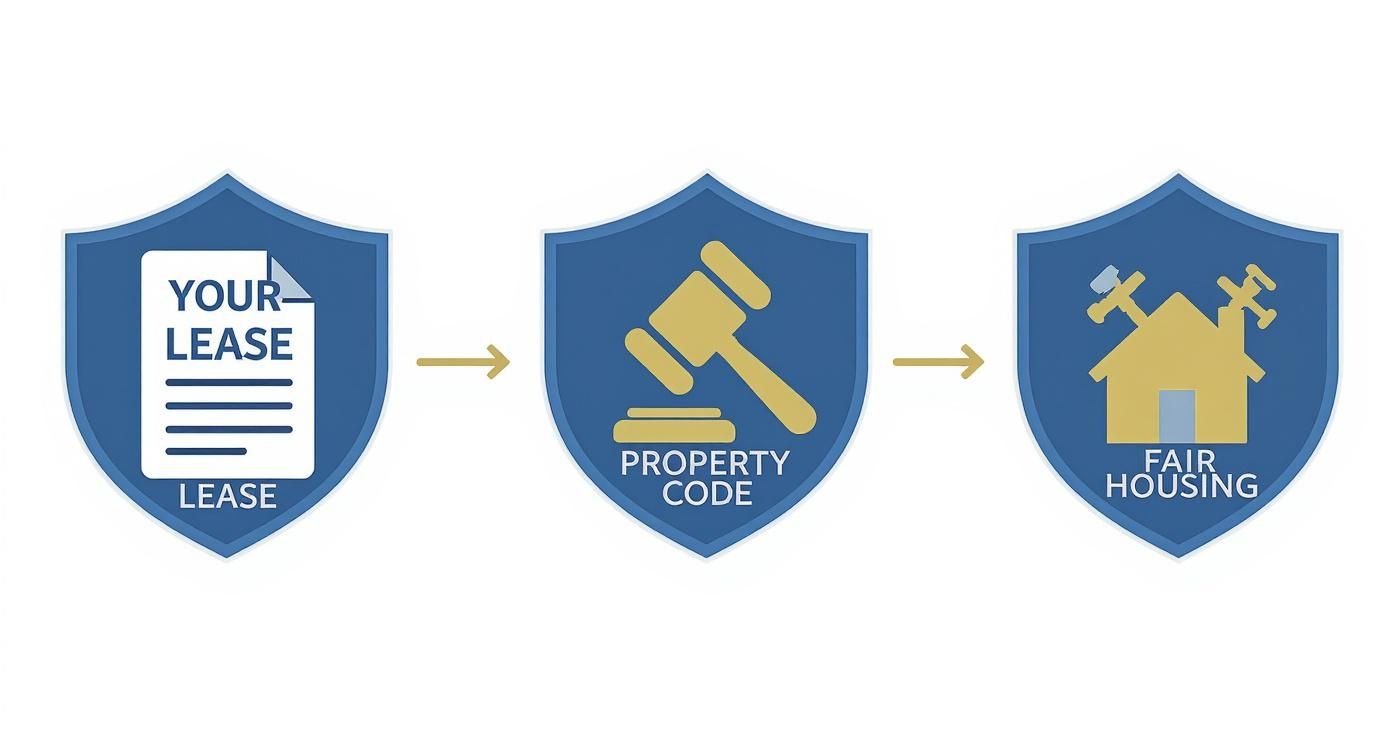
Think of your lease, the Texas Property Code, and Fair Housing laws as a powerful shield. Now, let’s talk about how to use it.
Step 1: Start Documenting Everything Immediately
From this moment forward, your most powerful tool is a detailed record of every single incident. Vague complaints are easy for a landlord to brush aside. But a meticulous log of dates, times, and specifics is hard evidence.
It's time to think like a detective building a case. Your file should include:
- A Written Log: Grab a notebook or start a digital document. For every incident, write down the date, time, a factual play-by-play of what happened, and who was there.
- Digital Evidence: Save every single harassing text, email, or voicemail. Don't just leave them on your phone—take screenshots and back them up somewhere safe.
- Photo and Video Proof: Did the landlord damage your property, enter without notice, or ignore a critical repair? Pull out your phone and get clear, timestamped photos or videos.
This evidence is the foundation for every letter you’ll send and every formal complaint you might file.
Step 2: Send a Formal Cease and Desist Letter
Once you've documented a clear pattern of harassment, it's time to put your landlord on official notice. Sending a formal cease and desist letter via certified mail (with a return receipt) does two critical things.
First, it’s an unmistakable, official demand for the behavior to stop.
Second, it creates a legal paper trail. This proves you tried to resolve the problem in good faith before taking bigger steps. If you end up in court, this piece of paper is invaluable.
Your letter needs to be professional, not emotional. Stick to the facts. Clearly state the specific actions you consider harassment, mention your right to "quiet enjoyment" under Texas law, and demand that the behavior cease immediately.
This single letter often signals a major shift. It tells your landlord you know your rights and aren’t going to be pushed around.
Step 3: File a Complaint with the Right Authority
If the letter doesn't work and the harassment continues, you need to bring in a third party. Where you go next depends on the type of harassment you're facing.
- Housing Discrimination: If the harassment is tied to your race, religion, sex, disability, or another protected class, your first call should be to the U.S. Department of Housing and Urban Development (HUD) or the Texas Workforce Commission.
- Code Violations: Is the harassment taking the form of refusing to make essential repairs? You’ll want to file a complaint with your city's local code enforcement department.
- Justice Court: For urgent issues like an illegal lockout or having your utilities shut off, you can go straight to your local Justice of the Peace court to get an immediate order forcing the landlord to restore access or services.
Knowing who to call is half the battle. For a deeper dive into this process, you can learn how to file a complaint against your landlord in our comprehensive guide.
Step 4: Partner with a Landlord Tenant Attorney
When you've done everything right and your landlord still won't listen, it's time to bring in a professional. A Texas landlord-tenant lawyer can look at the evidence you’ve gathered, tell you how strong your case is, and take over all communication with your landlord.
This is a game-changer. An attorney can escalate the fight by sending a formal demand from their law office, filing a lawsuit for you, and representing you in court. This step sends a clear message to your landlord that you are serious.
How Harassment Can Lead to Illegal Eviction
For many tenants, the number one fear is that speaking up will get them kicked out. Some landlords use harassment as a weapon to make your life so miserable that you give up and leave, saving them the trouble of a proper eviction.
This isn't just bad behavior; it’s a strategy. And it’s often the first step toward an illegal eviction—specifically, what the law calls a retaliatory eviction. Understanding how these two things are connected is the key to protecting your rights.
Let's be clear: Texas has a fast, landlord-friendly eviction process. This can make some landlords bold, encouraging them to cut corners because they assume tenants won't know their rights. The numbers are staggering—over 164,000 evictions were filed in one year across major Texas cities. You can see more about Texas eviction trends on nlihc.org.
What is a Retaliatory Eviction?
A retaliatory eviction is when a landlord tries to evict you as punishment for exercising a legal right. The Texas Property Code is very clear: your landlord cannot penalize you for things like formally requesting essential repairs or reporting them to a housing authority for a code violation.
If you take one of those protected actions and, almost like clockwork, an eviction notice appears on your door, you may be facing an illegal eviction.
Here’s a classic real-world scenario:
- You send your landlord a certified letter demanding they fix a serious mold problem.
- A week or two later, you get a three-day notice to vacate. The reason is vague, like a "lease violation" with no real explanation.
That timing is more than suspicious. The law automatically presumes an eviction is retaliatory if the landlord files it within six months of you exercising your rights. The burden of proof is now on the landlord—they have to prove they had a legitimate, non-retaliatory reason for wanting you out.
Key Takeaway: An eviction notice isn't the end of the road. It's the start of a legal fight. If you believe it’s retaliation for you reporting harassment or other problems, you have the right to challenge it in court.
How Your Documentation Becomes Your Shield in Court
This is the moment where all that record-keeping pays off. Your log of incidents, saved emails, photos, and copies of certified letters are the hard evidence that can stop an illegal eviction cold.
When you go to the Justice Court for the eviction hearing, you can present all of this to the judge. Your job is to paint a clear picture:
- First, you documented ongoing harassment or a serious issue with the property.
- Next, you took a legally protected action (like sending a formal repair request).
- Finally, the landlord hit you with an eviction notice right after.
That documented timeline shows the judge that the eviction isn't really about a late fee—it's punishment because you stood up for yourself. A judge who sees a clear pattern of retaliation can throw the eviction case out entirely.
Getting familiar with the eviction process in Texas will give you a major advantage. Having an experienced eviction attorney by your side is even better. They know how to present your evidence effectively and ensure your rights are fully protected.
When to Hire an Attorney and Seek Damages
You’ve sent the letters. You’ve filed the complaints. You’ve documented everything. But the harassment just won’t stop.
When your landlord refuses to respect your rights, it’s time to escalate. Taking legal action is intimidating, but it’s often the only way to get a court to step in, force the behavior to stop for good, and hold your landlord financially accountable for their actions.
This is the point where hiring a Texas landlord-tenant lawyer isn’t just an option—it’s a critical next step. An experienced attorney can take the mountain of evidence you’ve collected—the logs, photos, and threatening emails—and build a powerful legal case on your behalf.
Understanding Your Legal Options
When you sue a landlord for harassment, you’re not just asking them to stop. You’re seeking justice for the harm they’ve caused. An attorney will help you figure out the best path forward.
Here’s what you can fight for:
- A Court Injunction: This is a formal order from a judge that legally forces your landlord to stop the harassing behavior immediately.
- Actual Damages: You can demand financial compensation for losses you incurred because of the harassment, such as the cost of a temporary hotel stay or therapy for emotional distress.
- Statutory Penalties: Texas law allows you to seek specific financial penalties for certain violations, making them pay for breaking the law.
Pursuing Financial Compensation
The financial stakes for a landlord who harasses their tenant can be significant. The threat of a substantial financial award is a powerful incentive for landlords to stop their illegal behavior.
You can seek compensation for statutory damages, which can be one month's rent plus $1,000, on top of damages for emotional distress and, in the worst cases, even punitive awards meant to punish the landlord. You can learn more about tenant protections in Texas on texashousers.org.
That detailed log of incidents, emails, and photos you’ve been keeping? It’s more than just a record—it’s the evidence that builds the entire foundation of your case for damages. Every documented event strengthens your claim.
An eviction attorney can look at your case and calculate the full extent of damages you’re entitled to claim. You shouldn’t have to carry the financial or emotional burden of your landlord’s illegal behavior. The law is designed to make you whole again.
Your Questions About Landlord Harassment in Texas—Answered
Tenants often have a lot of questions when they feel they're being pushed around. Here are some of the most common issues we see.
Can my landlord just walk into my apartment whenever they want?
Absolutely not, unless it’s a true emergency like a fire or a major flood. Your lease agreement should spell out exactly how much notice your landlord has to give before entering. If they repeatedly show up unannounced, it could be a form of harassment.
What if my landlord shuts off my water or electricity?
That's a major violation and is completely illegal. Under the Texas Property Code, cutting off your utilities is considered an illegal lockout. You have the right to take them to court, sue for damages, and get a judge to order the services restored immediately.
What if the harassment is just words? Is that illegal too?
Yes, it can be. Harassment isn't just about physical actions. If your landlord is constantly threatening you, yelling at you, or doing anything else to make you feel unsafe in your own home, that’s a pattern of intimidation—and it’s against the law.
I think I'm being harassed. What's the very first thing I should do?
Start a paper trail. Right now. Stop what you’re doing and write down what just happened. Save every text and email. If you can safely take photos or videos of an incident, do it.
When it comes to landlord harassment in Texas, solid documentation is your single most powerful tool.
Key Steps to Protect Yourself
If you're facing this situation, don't just hope it goes away. You have to be proactive.
- Document everything. Keep a detailed log with dates, times, and a description of every incident. This is your evidence.
- File a formal complaint. You can file a complaint with your local housing authority or the justice court in your precinct.
- Talk to a lawyer. A Texas landlord-tenant lawyer can look at your evidence and give you a clear, no-nonsense game plan.
When to Get Legal Help
If you've sent a formal letter to your landlord and the harassment is still happening, it's time to bring in a professional. An eviction attorney can help you file for an injunction to make the behavior stop and sue for statutory damages.
Dig Deeper with These Resources
- Get to know your rights under the Texas Property Code by reading our comprehensive Tenant Rights Guide.
- Ready to take action? Our tutorial on How to File a Complaint Against Your Landlord walks you through the steps.
- Worried this might lead to an eviction? Understand what you’re up against with our Texas Eviction Process Guide.
These guides are designed to give you clear, step-by-step advice to help you protect your rights and navigate this stressful process with confidence. Don't wait. The deadlines in these cases can be tight, so acting quickly to preserve your evidence and consult an attorney is the best way to build a strong case.
If you need help with an eviction, lease issue, or rental dispute, contact The Law Office of Bryan Fagan, PLLC for a free consultation today.

![Graphic design featuring the title "8 Valid Reasons to Break a Lease in Texas [2025 Guide]" with decorative elements like a pen and paper, emphasizing tenant rights and legal guidance in Texas.](https://texastenantlawyers.com/wp-content/uploads/2025/11/featured-image-7ebe2aec-eacb-4e61-8e85-9c298b07ad11.jpg)